
Introduction
Understanding how the human body moves and responds to physical forces is important in biomechanics, medical research, ergonomics, rehabilitation, and product development. Researchers and engineers often need more than visual observation to study movement. They require computational tools that can estimate muscle activity, joint forces, and mechanical loads under different conditions.
AnyBody Modelling System 8.2.2 is a specialized biomechanical simulation platform designed for analyzing the mechanics of the human body. It allows users to build and evaluate musculoskeletal models, study movement, and investigate how muscles, joints, and external forces interact during physical activities.
The software is particularly relevant to researchers, biomechanical engineers, and professionals working with human movement analysis and musculoskeletal simulation.
What Is AnyBody Modelling System 8.2.2?
AnyBody Modelling System is a computational platform for studying the mechanical behavior of the human musculoskeletal system. It allows users to create digital models containing bones, joints, muscles, and other mechanical components, then simulate how these structures behave during different physical activities.
The software uses mathematical modeling and biomechanical calculations to estimate internal forces that are difficult to measure directly. These may include individual muscle forces, joint reaction forces, and other mechanical loads.
An important part of its ecosystem is the AnyBody Managed Model Repository (AMMR). It provides reusable human body models, components, and example applications that can help users start projects without building every model from scratch.
Version 8.2.2 was released on October 12, 2026. It is a maintenance update that introduces improvements to custom joint functionality, licensing compatibility, and technical documentation rather than a complete redesign of the platform.
AnyBody Technology+1
Key Features of AnyBody Modelling System 8.2.2
1. Advanced Musculoskeletal Modeling
The software provides a flexible environment for representing the mechanical structure of the human body. Users can work with models containing bones, joints, muscles, and connected mechanical elements.
These models can be adjusted to investigate different body configurations and movement conditions. Researchers can modify model parameters, define mechanical relationships, and examine how individual components contribute to overall movement.
This capability is useful for studying walking, lifting, sports activities, workplace movements, and other biomechanical scenarios.
2. Muscle Force and Activity Analysis
One of the platform’s central capabilities is estimating muscle forces and activity during simulated movements.
AnyBody uses biomechanical calculations to investigate how different muscles contribute to a particular movement. The resulting data can help researchers examine muscle recruitment, force distribution, and physical loading patterns.
This functionality can support research involving:
-
Muscle force estimation
-
Physical workload evaluation
-
Movement efficiency
-
Sports biomechanics
-
Human-device interaction
-
Musculoskeletal research
By examining estimated muscle forces, researchers can better understand the mechanical demands associated with different activities.
3. Inverse Dynamics Simulation
Inverse dynamics is an important technique in biomechanical analysis. It helps calculate the forces and moments associated with an observed movement.
AnyBody uses movement information and external loading conditions to estimate internal mechanical responses. This makes it possible to investigate muscle forces and joint reactions during activities such as walking, running, lifting, and other physical movements.
The results can provide useful information for biomechanics research, ergonomic assessment, and the evaluation of human-machine interactions.
4. Joint Reaction Force Analysis
Joint loading is an important subject in biomechanics and orthopedic engineering. AnyBody provides tools for estimating forces and moments acting within joints during simulated activities.
Users can examine how different movements, body configurations, and external loads influence joint reactions. This can support research involving the knee, hip, shoulder, spine, and other joints.
Such analysis may also contribute to the evaluation and development of orthopedic implants, assistive equipment, and related technologies.
5. AnyBody Managed Model Repository (AMMR)
The AnyBody Managed Model Repository (AMMR) is an important part of the software ecosystem. It contains reusable musculoskeletal models, body components, and example applications for different research areas.
Instead of developing every model from the beginning, users can start with available resources and modify them according to their project requirements.
The repository includes examples related to:
-
Activities of daily living
-
Gait and motion analysis
-
Orthopedic biomechanics
-
Sports science
-
Workplace ergonomics
-
Exoskeleton development
-
Motion capture applications
These resources can help researchers understand modeling concepts and develop more advanced simulation projects.
6. Motion Capture Integration
Motion capture technology is commonly used to record human movement in laboratories and research environments. AnyBody supports workflows involving motion capture data, including C3D and BVH formats.
Users can apply recorded movement information to compatible musculoskeletal models and investigate the resulting mechanical behavior.
The platform also provides model scaling and motion-related configuration options. The 8.2 release introduced improvements to motion capture handling, including support for rotation data in C3D files and additional model configuration options.
These capabilities are useful for gait analysis, sports research, movement studies, and human performance evaluation.
7. Custom Joint Modeling in Version 8.2.2
One of the specific improvements in version 8.2.2 concerns the AnyStdJointCustom class.
In the initial 8.2 release, its customization options were locked, limiting its functionality. Version 8.2.2 enables these options so users can create custom joints for more flexible mechanical modeling.
This improvement is particularly relevant to developers and researchers who build specialized models or need to represent mechanical connections that do not fit standard joint configurations.
8. Force-Dependent Kinematics
Force-Dependent Kinematics (FDK) provides a way to investigate movement while considering the influence of mechanical forces.
This functionality can be valuable when studying situations in which the position or movement of a body component depends on applied forces from muscles, ligaments, surfaces, or other mechanical elements.
Researchers can use it to explore complex interactions between joints, muscles, and external systems. It can also support studies involving orthopedic devices, assistive equipment, and human-machine interaction.
9. Interactive 3D Visualization
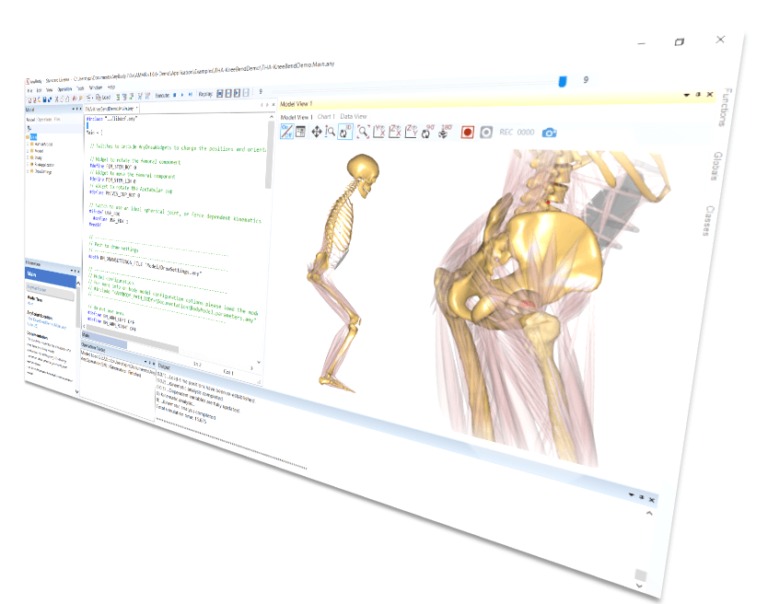
Visual interpretation is important when working with complex biomechanical models. AnyBody includes a graphical environment for viewing model structures and examining simulation results.
Its working environment provides several useful tools:
-
Model View: Displays the three-dimensional biomechanical model.
-
Model Tree: Organizes model components and their relationships.
-
Chart View: Presents simulation results through graphical plots.
-
AnyScript Editor: Provides an environment for creating and modifying model definitions.
-
Output and Progress Views: Display messages, warnings, errors, and simulation status.
These tools help users inspect model configurations, understand simulation behavior, and review calculated results.
10. Updated Licensing and Documentation
The 8.2.2 release includes an update to the Reprise License Manager (RLM), moving it to version 18. This enables compatibility with newer RLM license server versions.
The reference manual has also been updated with additional code examples. These examples can help users understand modeling functions and work more effectively with the software’s scripting environment.
These changes are useful for maintaining a reliable development and simulation workflow.
AnyScript Modeling Language
AnyBody uses AnyScript, an object-oriented modeling language designed to describe musculoskeletal systems and their interactions with external environments.
Through AnyScript, users can define body segments, joints, forces, movement drivers, and other mechanical elements. This provides greater control over model construction and simulation settings.
The scripting environment is particularly useful for advanced users who need to customize existing models, develop new biomechanical configurations, or automate repetitive modeling tasks.
Applications and Industries
AnyBody Modelling System supports several professional and academic applications.
Biomechanics Research: Researchers can investigate muscle activity, joint loading, movement mechanics, and human performance.
Orthopedic Engineering: Engineers can study joint reactions and evaluate the mechanical behavior of orthopedic implants and related devices.
Sports Science: Specialists can analyze movement patterns, physical loading, and biomechanical performance during sports activities.
Workplace Ergonomics: Organizations can evaluate physical demands associated with working positions, manual handling, and equipment use.
Exoskeleton Development: Designers can study how assistive devices interact mechanically with the human body.
University Education: Academic institutions can use musculoskeletal models to teach biomechanics, simulation techniques, and human movement analysis.
System Requirements and Compatibility
AnyBody Modelling System is a Windows-based desktop application intended for professional modeling and simulation workflows. Since biomechanical simulations can involve detailed models and repeated calculations, suitable hardware is important for a comfortable working experience.
Before installation, users should review the requirements for version 8.2.2 and check the following:
-
Compatible 64-bit Windows environment
-
Supported processor and memory configuration
-
Available storage space
-
Graphics compatibility
-
Licensing and activation requirements
-
Compatibility with the required AMMR version
For larger models and demanding simulation tasks, a modern workstation with sufficient RAM and processing power can be beneficial. Exact minimum and recommended specifications should be confirmed from the documentation for the selected release.
Conclusion
AnyBody Modelling System 8.2.2 is a specialized software platform for musculoskeletal modeling, biomechanical simulation, and human movement analysis. Its combination of detailed body models, muscle force estimation, inverse dynamics, motion capture integration, and interactive visualization provides a flexible environment for research and engineering applications.
The 8.2.2 maintenance release introduces practical improvements to custom joint development, licensing compatibility, and reference documentation. Combined with the broader capabilities of the AnyBody platform and its Managed Model Repository, these tools support projects involving biomechanics, ergonomics, orthopedics, sports science, and assistive technology.
For researchers, academic teams, and engineering professionals who need to investigate the mechanical behavior of the human body through computational modeling, AnyBody Modelling System offers a comprehensive environment for developing and analyzing musculoskeletal simulations.
Our Paid Service
If you want to Purchase Cracked Version / KeyGen Activator /License Key
Contact Us on our Telegram ID :
Crack Software Policies & Rules:
Lifetime Activation, Unlimited PCs/Users,
You Can test through AnyDesk before Buying,
And When You Are Satisfied, Then Buy It.
 Sajeel Irfan