
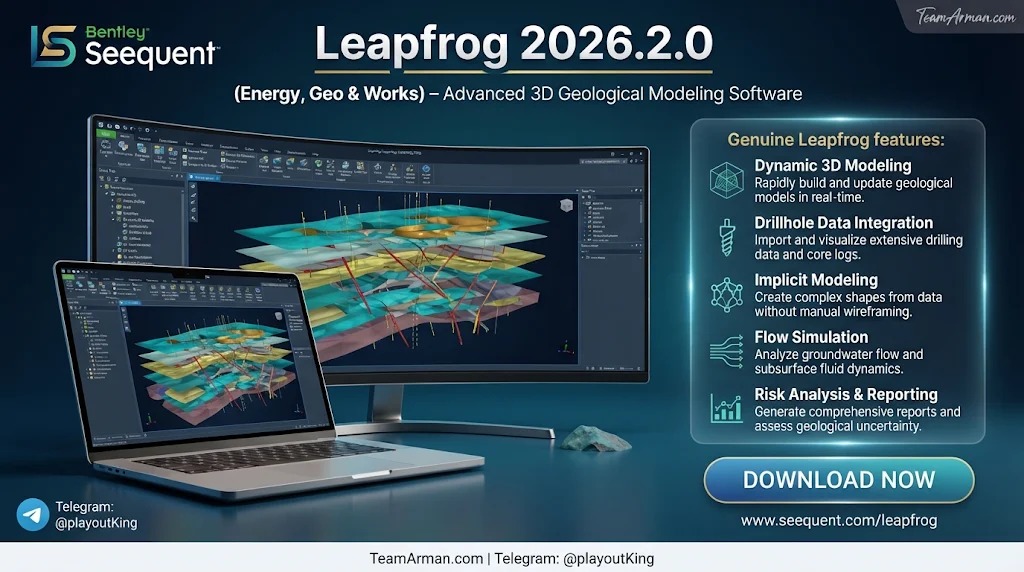
Introduction
Understanding what lies beneath the Earth’s surface is essential for mining, energy exploration, civil engineering, and environmental projects. Geological teams work with large volumes of drilling information, structural measurements, survey records, and other subsurface data. Converting these datasets into accurate 3D models can be challenging without specialized software. Bentley Seequent Leapfrog 2026.2 provides a collection of professional geological modeling applications designed to help specialists interpret subsurface conditions and visualize complex geological environments.
The Leapfrog software family includes specialized solutions such as Leapfrog Geo, Leapfrog Energy, and Leapfrog Works. Each application addresses different industry requirements, from mineral exploration and resource development to energy projects, geotechnical investigations, and infrastructure construction.
Version 2026.2 continues the platform’s development with improvements to geological modeling, data handling, and project workflows. Its tools help professionals create interactive 3D representations, examine geological relationships, and update interpretations as new information becomes available.
What Is Bentley Seequent Leapfrog 2026.2?
Bentley Seequent Leapfrog is a professional 3D geological modeling platform used to interpret and visualize subsurface information. It helps users transform drilling data, geological observations, structural measurements, and other datasets into interactive digital models.
A major part of its workflow is implicit geological modeling. Instead of manually drawing every geological boundary across multiple sections, users can generate surfaces based on available data and geological interpretations. These models can then be refined as additional information is collected.
The platform is particularly useful for projects where geological understanding changes as exploration, drilling, or site investigation progresses. Its applications support different industries while providing specialized tools for their respective workflows.
Main Applications in the Leapfrog Software Family
1. Leapfrog Geo – Geological and Mining Modeling
Leapfrog Geo is designed primarily for geologists working in mineral exploration and mining. It provides tools for building 3D geological models from drillholes, structural measurements, geological contacts, and other exploration data.
Its implicit modeling engine helps users create geological surfaces and investigate relationships between different rock units. Models can be updated when new drilling information or geological observations are added.
Important capabilities include:
- 3D geological modeling and interpretation
- Drillhole data integration
- Structural interpretation and modeling
- Stratigraphic modeling
- Vein and fault modeling
- Numerical data visualization
- Exploratory data analysis
- Block model visualization and interrogation
These capabilities help exploration teams examine geological structures, investigate mineralization patterns, and compare alternative interpretations.
2. Leapfrog Energy – Subsurface Energy Modeling
Leapfrog Energy focuses on geological modeling workflows for energy-related projects. It provides tools for interpreting underground structures and organizing subsurface information that supports exploration, development, and operational planning.
Energy professionals can use geological models to examine formations, structural relationships, and relevant subsurface data. The ability to combine multiple datasets in a 3D environment helps teams develop a clearer understanding of geological conditions.
Depending on the project and available extensions, workflows can support applications related to geothermal energy, hydrocarbon exploration, and other subsurface energy developments.
3. Leapfrog Works – Civil and Environmental Engineering
Leapfrog Works is designed for civil engineering, geotechnical, hydrogeological, and environmental projects. It helps engineers transform site investigation information into 3D ground models that can be used to understand subsurface conditions.
The application supports modeling based on borehole records, geological observations, GIS information, and other investigation datasets.
Typical applications include:
- Geotechnical ground modeling
- Engineering geological interpretation
- Hydrogeological modeling
- Contaminant plume visualization
- Infrastructure site investigation
- Geological cross-section generation
- Subsurface risk assessment
These capabilities can support engineering teams when evaluating ground conditions for tunnels, foundations, dams, excavations, and other infrastructure projects.
Key Features of Leapfrog 2026.2
1. Advanced Implicit Geological Modeling
Leapfrog uses implicit modeling technology to generate geological surfaces from available datasets. Users can define geological relationships and refine interpretations through interactive modeling tools.
This approach can reduce the time spent creating manual geological boundaries and makes it easier to investigate alternative geological scenarios.
When new information becomes available, relationally linked models can be updated to reflect the revised project data.
2. Integrated Geological Data Management
Subsurface projects often involve information from multiple sources. Leapfrog provides a shared 3D workspace for bringing different datasets together.
Depending on the application, supported information can include:
- Drillhole databases
- Geological contact points
- Structural measurements
- GIS lines and maps
- Block models
- Geophysical datasets
- Survey and site investigation information
- Numerical geological data
Combining these records helps professionals examine geological information in its spatial context instead of reviewing disconnected datasets.
3. Interactive 3D Visualization
The platform provides interactive 3D visualization tools for inspecting geological models and investigating relationships between different underground structures.
Users can examine surfaces, drillholes, geological units, and numerical information from different viewing angles. This makes it easier to identify potential inconsistencies and communicate interpretations to project stakeholders.
3D scenes can also support technical discussions between geologists, engineers, and project managers.
4. Structural Modeling and Interpretation
Structural information is important when interpreting faults, folds, veins, and other geological features.
Leapfrog Geo provides tools for working with structural measurements and incorporating them into geological interpretations. Users can investigate structural orientations and use these observations to guide model construction.
This is particularly valuable in projects involving complex geological environments where structural relationships influence the interpretation of mineral deposits.
5. Drillhole Data Analysis
Drillhole information is one of the most important sources of geological evidence in exploration and site investigation projects.
Leapfrog supports the integration and visualization of drilling records, allowing users to examine lithology, geological contacts, and other logged intervals in a 3D environment.
By combining drillhole data with geological surfaces and structural information, specialists can develop more connected interpretations of underground conditions.
6. Dynamic Model Updating
Geological interpretations often change when new drilling results or site investigation records become available.
Leapfrog’s relational modeling approach allows supported model components to respond to changes in their underlying data. This helps reduce the need to rebuild entire models whenever project information is updated.
The result is a more flexible modeling workflow for projects that develop over time.
What’s New in Leapfrog 2026.2?
The 2026.2 release introduces improvements across the Leapfrog product family. The Geo release includes several enhancements to geological and structural modeling.
Notable Leapfrog Geo improvements include:
Improved Vein Modeling: Users can add additional internal contact data to constrain veins. This helps prevent modeled vein walls from cutting through known internal rock units.
Advanced Stratigraphy Improvements: Users can create an Advanced Stratigraphy sequence directly from an existing Basic Stratigraphy, inheriting its ordered lithology list.
Drillhole-Aware Surface Modeling: A new option helps prevent stratigraphic surfaces from cutting through logged drillhole intervals.
Contact Interpretation Improvements: The release adds better control over contact prioritization and provides additional ways to inspect contact younging direction and magnitude.
Surface Thickness Visualization: Advanced stratigraphic surfaces can be colored according to thickness-related distance values, helping users examine changes in geological thickness.
Improved Drillhole Interval Handling: The modeling workflow can retain valid intervals from partially valid drillholes instead of excluding the entire drillhole when some intervals are out of order.
Fault Chronology Editing: Users can select and reorder multiple faults together, making complex fault chronology management more convenient.
Bulk Polarity Editing: Structural disks can be selected together and have their polarity set, inverted, or flipped in a bulk operation.
Leapfrog Works 2026.2 is also available as a point release that addresses issues identified in version 2026.1. Users should review the relevant release notes for application-specific changes before upgrading.
Benefits for Geological and Engineering Teams
More Efficient Geological Interpretation
Implicit modeling and integrated data tools help professionals develop geological interpretations without relying entirely on manual surface construction.
Better Understanding of Subsurface Conditions
Interactive 3D visualization provides a clearer way to examine geological structures, drilling records, and underground relationships.
Flexible Project Updates
Relational model workflows help teams incorporate new information into existing projects and revise interpretations as investigations progress.
Improved Technical Communication
3D models, cross-sections, and visual outputs can help communicate complex geological findings to technical teams and other stakeholders.
Support for Multiple Industries
The different Leapfrog applications address requirements across mining, energy, civil engineering, geotechnical investigation, and environmental projects.
System Requirements and Compatibility
Leapfrog applications can have different hardware and software requirements depending on the selected product, project size, and modeling workload.
Before installing version 2026.2, users should verify:
- Supported Windows operating system
- Processor and memory requirements
- Graphics hardware compatibility
- Available storage space
- Required database and network components
- Compatibility with existing geological data sources
- Licensing and account requirements
- Supported input and output file formats
Large geological projects can contain extensive drilling records and complex 3D surfaces. A capable workstation with sufficient memory and graphics performance is recommended for demanding modeling tasks.
Users should also sign out of their existing application before upgrading, following the upgrade guidance provided for the relevant Leapfrog product.
Who Should Use Bentley Seequent Leapfrog?
Leapfrog can be useful for professionals and organizations working in several technical fields:
- Geologists: For geological interpretation and 3D subsurface modeling.
- Mining Engineers: For understanding geological structures and supporting exploration workflows.
- Energy Professionals: For subsurface modeling and energy development projects.
- Geotechnical Engineers: For interpreting ground conditions and engineering geology.
- Hydrogeologists: For supporting groundwater-related modeling workflows.
- Environmental Consultants: For investigating subsurface conditions and environmental risks.
- Civil Engineering Teams: For understanding ground conditions during infrastructure planning.
The appropriate application depends on the type of project. Leapfrog Geo, Energy, and Works are specialized products rather than interchangeable names for one identical software package.
Final Thoughts
Bentley Seequent Leapfrog 2026.2 provides a professional collection of 3D geological modeling applications for interpreting and visualizing subsurface information. Its implicit modeling technology, integrated data workflows, structural interpretation tools, and interactive visualization capabilities support a wide range of geological and engineering activities.
Leapfrog Geo is particularly relevant to mining and geological exploration, Leapfrog Energy addresses energy-related subsurface workflows, and Leapfrog Works supports civil, geotechnical, and environmental projects.
The 2026.2 update brings useful refinements to geological interpretation and modeling workflows, especially in Leapfrog Geo. For organizations working with complex underground data, the platform offers a structured environment for building, reviewing, and updating 3D models.
Before selecting an application or upgrading, users should confirm the exact product edition, licensing requirements, system compatibility, and available features for their intended workflow.
Our Paid Service
If you want to Purchase Cracked Version / KeyGen Activator /License Key
Contact Us on our Telegram ID :
Crack Software Policies & Rules:
Lifetime Activation, Unlimited PCs/Users,
You Can test through AnyDesk before Buying,
And When You Are Satisfied, Then Buy It.