
Introduction
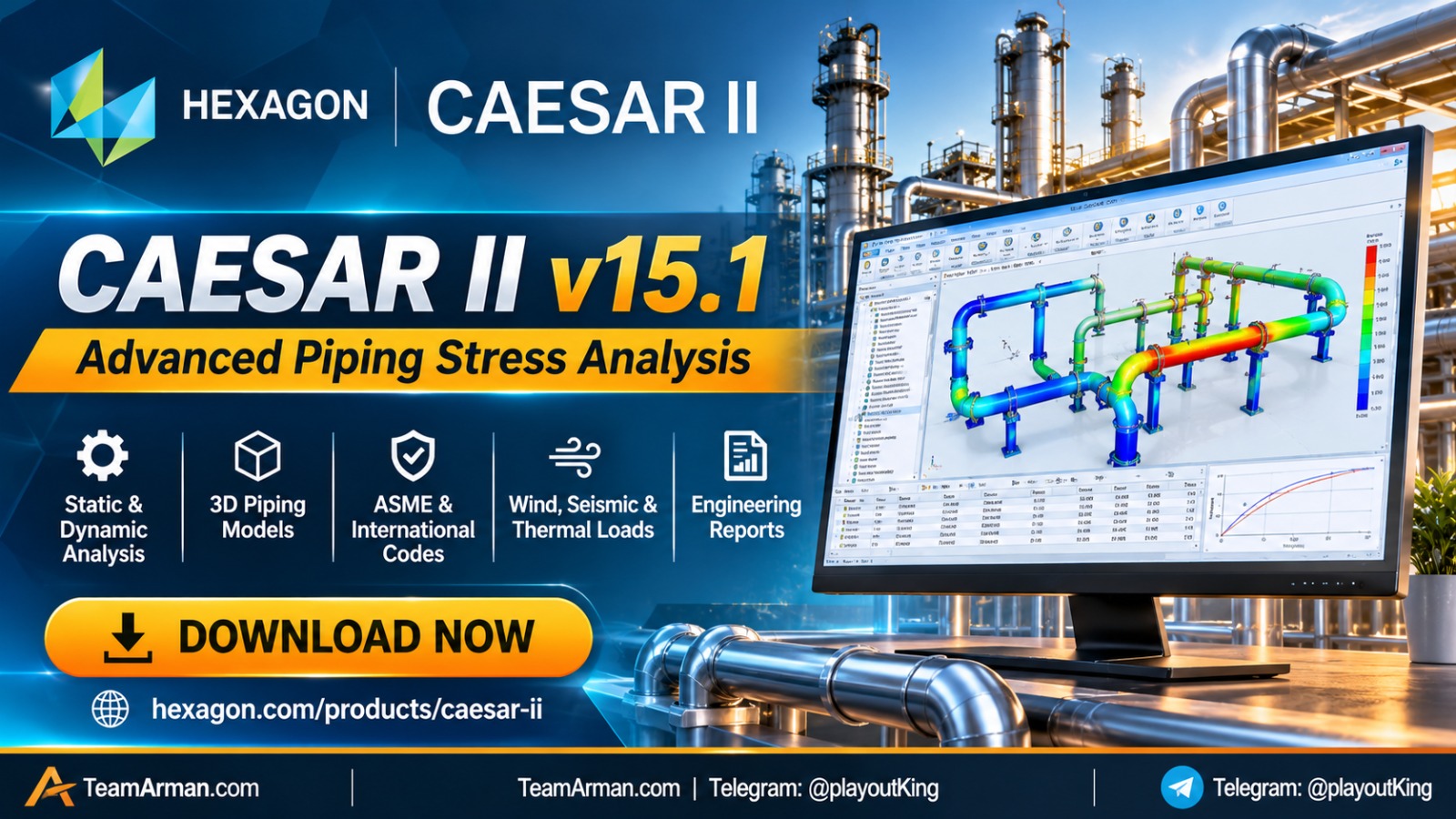
Industrial piping systems are essential components of power plants, refineries, chemical facilities, offshore installations, and manufacturing environments. These systems operate under different mechanical and environmental conditions, including internal pressure, temperature variations, equipment loads, wind, and seismic activity. Engineers must evaluate how these conditions affect piping flexibility, structural integrity, and connected equipment. Hexagon CAESAR II v15.1 Build 15.01.00.0187 is a specialized engineering application developed to support these requirements through detailed piping stress analysis and mechanical design calculations.
CAESAR II provides tools for building piping models, defining operating conditions, evaluating stress levels, calculating displacements, and reviewing support reactions. It supports static and dynamic analysis while incorporating recognized international piping codes and engineering standards.
The software is intended for piping stress engineers, mechanical designers, plant engineering teams, and industrial consultants who need a structured environment for evaluating complex piping arrangements.
What Is Hexagon CAESAR II v15.1?
CAESAR II is professional piping stress analysis software developed by Hexagon for designing, evaluating, and analyzing industrial piping systems.
It allows engineers to create digital representations of piping arrangements and examine how they respond to different loading conditions. These models can include straight pipes, bends, tees, valves, equipment connections, restraints, supports, and other piping components.
The application calculates important engineering results, including:
- Piping stresses
- Displacements and movements
- Forces and moments
- Support reactions
- Equipment nozzle loads
- Structural response under different loading conditions
Engineers can compare calculated results with applicable design-code requirements and evaluate whether a piping arrangement needs modification.
Version 15.1 Build 15.01.00.0187 continues the CAESAR II engineering environment and introduces a New Analysis Reviewer for reviewing static analysis results and preparing reports.
Key Features of Hexagon CAESAR II v15.1
1. Advanced Piping Stress Analysis
Piping stress analysis is the primary function of CAESAR II. Industrial piping systems experience different forces throughout their operating life, and these forces can affect the mechanical performance of pipes, fittings, supports, and connected equipment.
CAESAR II provides an analysis environment for examining these conditions through engineering models and calculated results.
Its capabilities include:
- Sustained stress evaluation
- Expansion stress analysis
- Occasional load assessment
- Pressure-related stress calculations
- Thermal expansion evaluation
- Support and restraint load calculations
- Piping flexibility assessment
These functions help engineers identify potentially problematic locations and evaluate whether the piping arrangement satisfies the applicable design criteria.
2. Static Analysis Capabilities
Static analysis is used to evaluate piping systems under defined operating and environmental loading conditions.
CAESAR II calculates displacements, forces, moments, reactions, and stress results throughout the piping model.
Engineers can define different load cases to represent conditions such as:
- Operating temperature
- Internal pressure
- Pipe and fluid weight
- Equipment movement
- Wind loading
- Seismic loading
- Support settlement
- Hydrostatic testing
The results can be examined to understand how individual components and the overall piping arrangement respond to the selected conditions.
The software also includes tools for defining and managing static load cases, allowing engineers to evaluate multiple operating scenarios.
3. Dynamic Analysis and Vibration Evaluation
Some industrial piping systems experience changing or time-dependent loads. These may result from mechanical vibration, fluid movement, pressure transients, seismic events, or other dynamic conditions.
CAESAR II provides dynamic analysis capabilities for evaluating the response of piping systems under supported dynamic loading scenarios.
Depending on the analysis requirements, capabilities include:
- Modal analysis
- Harmonic analysis
- Response spectrum analysis
- Time-history analysis
- Force spectrum calculations
Dynamic analysis can help engineers investigate vibration-related concerns and evaluate the structural response of piping arrangements.
The appropriate analysis method depends on the physical problem, model assumptions, and applicable engineering criteria.
4. International Piping Codes and Standards
Engineering projects frequently operate under specific regional and international design requirements. CAESAR II includes support for numerous recognized piping codes and engineering standards.
Its code-related capabilities cover standards and requirements associated with:
- ASME B31.1
- ASME B31.3
- ASME B31.4
- ASME B31.8
- ASME B31.9
- ASME B31.12
- EN 13480
- Other supported international standards
Version 15 introduced updates for several code editions, including ASME B31.1 2024, ASME B31.3 2024, ASME B31.3 Chapter IX 2024, ASME B31J 2023, and B31G 2023.
The applicable code editions depend on the selected analysis configuration. Engineers should always verify the required edition for each project rather than assuming every available standard is interchangeable.
5. Piping Model Creation and 3D Visualization
Accurate model creation is essential for reliable piping analysis.
CAESAR II provides graphical modeling and input tools that allow users to represent piping geometry and define component properties.
Engineers can build models containing different piping elements, supports, restraints, and connected equipment.
The graphical environment supports:
- Three-dimensional piping visualization
- Component positioning
- Node identification
- Model inspection
- Geometry modification
- Display of calculated forces and displacements
Visual feedback helps users review model construction and identify potential input problems before completing the analysis.
6. Material Database and Component Properties
Material properties directly influence piping stress calculations. Incorrect material information can affect calculated stress levels, thermal expansion, and other engineering results.
CAESAR II includes material databases that help users select suitable materials for their piping models.
The software supports working with material information such as:
- Material specifications
- Allowable stress values
- Elastic properties
- Thermal expansion coefficients
- Temperature-dependent properties
- Component-specific material information
The application also provides databases and design-related information for items such as expansion joints, spring hangers, and other piping components.
Users should verify that the selected material data corresponds to the applicable code edition and project specifications.
7. Load Case Management
Industrial piping analysis often requires several combinations of operating and environmental loads.
CAESAR II provides load case management tools that allow engineers to define, organize, and review these combinations.
Common load case categories include:
- Operating conditions
- Sustained loads
- Expansion conditions
- Occasional loading
- Hydrostatic testing
- Wind and seismic conditions
The software supports defining multiple analysis cases and examining the results associated with each combination.
Proper load case selection is an important engineering responsibility. Engineers must ensure that the selected combinations represent the actual design conditions and applicable code requirements.
8. Equipment and Nozzle Load Evaluation
Piping systems are connected to equipment such as pumps, compressors, turbines, vessels, and other industrial machinery.
Loads transferred from connected piping can affect equipment performance and mechanical reliability.
CAESAR II includes equipment analysis capabilities that help engineers examine forces and moments acting on connected components.
Its equipment-related workflows support the evaluation of applicable requirements associated with:
- Rotating equipment
- Pressure vessels
- Equipment nozzles
- Connected piping loads
- Component interaction
These calculations can assist engineers in determining whether piping arrangements require changes to reduce excessive loads on connected equipment.
9. Wind, Wave, and Seismic Analysis
Industrial facilities can experience environmental forces that influence piping system behavior.
CAESAR II provides tools for evaluating supported environmental loading conditions, including wind, wave, and seismic effects.
These capabilities are particularly relevant to offshore facilities, power generation installations, and industrial structures exposed to environmental movement.
Engineers can define relevant environmental parameters and incorporate them into suitable analysis load cases.
The software also includes code-based environmental calculation options for supported standards and editions.
10. Advanced PCF Import and CAD Integration
Piping design information often originates in separate plant design applications. Recreating the complete geometry manually can require additional time and introduce unnecessary data-entry errors.
CAESAR II supports integration with compatible piping design workflows through PCF-based model exchange.
Its Advanced PCF Import functionality provides an interactive way to import piping information from supported design applications, including Smart 3D.
The integration environment can support:
- Piping geometry exchange
- Model import
- Design information transfer
- 3D model context
- Data export workflows
- Engineering model coordination
Imported geometry should still be checked carefully. The stress analyst must verify component properties, loads, restraints, and other analysis inputs before relying on the results.
11. New Analysis Reviewer in Version 15.1
One of the important additions in CAESAR II 15.1 is the New Analysis Reviewer.
This module provides a modern environment for reviewing static analysis results and preparing engineering reports.
Its capabilities include:
- Graphical and tabular result viewing
- Combined visualization of analysis information
- Heat map displays
- Displacement review
- Report generation
- Live report previews
- Improved report publishing performance
The New Analysis Reviewer supplements the existing Output Reviewer rather than completely removing the traditional review environment.
This gives users an updated way to examine calculated results and prepare documentation while retaining access to the classic output processor.
12. Reporting and Engineering Documentation
Engineering analysis requires clear documentation so that results can be reviewed, communicated, and retained for project records.
CAESAR II provides output processing and reporting capabilities for presenting important analysis information.
Reports can include:
- Stress summaries
- Displacement results
- Support reactions
- Element forces and moments
- Equipment load information
- Load case results
- Engineering calculation details
The New Analysis Reviewer in version 15.1 adds an updated reporting workflow with graphical and tabular result presentation.
These capabilities help engineering teams organize analysis findings and communicate important design information.
What’s New in CAESAR II v15.1 Build 15.01.00.0187?
Version 15.1 introduces an updated analysis review environment and additional improvements to the existing CAESAR II platform.
Important highlights include:
New Analysis Reviewer: A modern interface for reviewing static analysis results and generating reports.
Graphical and Tabular Results: Users can examine visual and numerical analysis information together.
Heat Maps and Displacements: Additional result visualization options help users understand the behavior of piping models.
Live Report Preview: Report documents can be reviewed before final publication.
Classic Output Processor: The traditional output review environment remains available.
Build Identification: Hexagon’s version information identifies Build 15.01.00.0187 with a build date of February 16, 2026.
The exact changes included in an individual installation should be checked against its release documentation and installed configuration.
Who Can Benefit from CAESAR II?
CAESAR II is designed for professionals involved in industrial piping design and engineering analysis.
Piping Stress Engineers: Engineers can model piping systems, define operating conditions, and evaluate stress and displacement results.
Mechanical Engineers: Mechanical professionals can investigate piping flexibility, equipment loads, and mechanical behavior under different conditions.
Power Plant Engineers: The software can support the evaluation of piping arrangements in power generation facilities.
Oil and Gas Professionals: Engineering teams can use its analysis capabilities for refinery, pipeline, and process facility projects.
EPC Contractors: Engineering, procurement, and construction organizations can incorporate piping stress calculations into plant engineering workflows.
Engineering Consultants: Consulting teams can prepare analysis models, examine code compliance, and generate technical documentation.
Benefits of Using Hexagon CAESAR II v15.1
CAESAR II offers several capabilities that support professional piping analysis.
- Comprehensive Stress Analysis: Evaluate piping behavior under different mechanical and environmental conditions.
- Static and Dynamic Calculations: Examine both steady-state and time-dependent loading scenarios.
- Code-Based Evaluation: Work with supported international piping codes and standards.
- 3D Model Visualization: Inspect piping geometry and review analysis results graphically.
- Material Databases: Access engineering material properties and component information.
- Load Case Management: Organize different operating and design conditions.
- Equipment Analysis: Evaluate applicable connected equipment and nozzle loads.
- CAD Integration: Exchange supported piping geometry with compatible design applications.
- Updated Reporting: Use the New Analysis Reviewer for graphical result inspection and report preparation.
The accuracy of engineering results still depends on correct model construction, suitable input data, code selection, and professional interpretation.
System Requirements and Compatibility
Before installing CAESAR II v15.1 Build 15.01.00.0187, users should review the requirements for the exact software release.
Important considerations include:
- Supported Windows operating system
- Compatible processor architecture
- Sufficient RAM for large piping models
- Suitable graphics hardware
- Available storage space
- Required Microsoft runtime components
- Smart Licensing compatibility
- Network access for license activation where required
CAESAR II uses Smart Licensing for license management. Users who need to work offline should review the available license checkout procedures before leaving an internet-connected environment.
Exact minimum and recommended hardware specifications should be confirmed using the applicable installation documentation.
Tips for Getting Better Results with CAESAR II
A reliable piping analysis workflow requires more than running calculations. Engineers should carefully review model assumptions and input information.
- Build an accurate piping model: Verify pipe dimensions, component locations, and node information.
- Select the correct piping code: Use the code and edition specified by the project requirements.
- Check material properties: Confirm that material data matches the selected temperature range and design standard.
- Define realistic load cases: Include relevant operating, thermal, pressure, and environmental conditions.
- Review supports and restraints: Ensure that boundary conditions represent the actual installation.
- Run error checking: Correct model input issues before performing the final analysis.
- Examine critical results: Review stress values, displacements, reactions, and equipment loads.
- Document engineering decisions: Maintain clear reports and records for technical review.
These practices help improve model quality and make engineering results easier to evaluate.
Frequently Asked Questions
1. What is Hexagon CAESAR II used for?
CAESAR II is used for piping stress analysis, flexibility evaluation, static and dynamic calculations, equipment load assessment, and engineering reporting.
2. Does CAESAR II support static and dynamic analysis?
Yes. The software supports static and dynamic piping analysis, including modal, harmonic, response spectrum, and time-history methods.
3. Which piping codes does CAESAR II support?
It supports numerous international standards, including applicable editions of ASME B31.1, B31.3, B31.4, B31.8, B31.9, B31.12, and EN 13480.
4. What is new in CAESAR II 15.1?
A major addition is the New Analysis Reviewer, which provides updated graphical and tabular result visualization, heat maps, displacement review, and improved report generation.
5. Can CAESAR II import piping models from CAD applications?
Yes. It supports compatible PCF-based exchange workflows, including Advanced PCF Import for supported piping design applications.
6. Can CAESAR II evaluate equipment nozzle loads?
Yes. Its equipment analysis capabilities support the evaluation of applicable forces and moments transferred from connected piping systems.
7. Is CAESAR II suitable for large industrial projects?
Yes. The software is designed to analyze piping models of different sizes and complexities, including industrial plant and pipeline applications.
8. Does CAESAR II require an internet connection?
Smart Licensing uses cloud-based license management. Offline work may be possible through the supported license checkout process, which should be arranged in advance.
Conclusion
Hexagon CAESAR II v15.1 Build 15.01.00.0187 is a specialized engineering solution for evaluating the mechanical behavior and structural performance of industrial piping systems. Its combination of static and dynamic analysis, international code support, material databases, equipment evaluation, and CAD integration provides a comprehensive environment for professional piping stress engineering.
The addition of the New Analysis Reviewer further improves the way engineers inspect static analysis results and prepare technical reports. Combined with its established modeling and calculation capabilities, CAESAR II supports a wide range of engineering activities across power generation, oil and gas, chemical processing, and industrial plant design.
For professionals responsible for piping flexibility, stress evaluation, and mechanical engineering documentation, CAESAR II offers a dedicated platform for analyzing complex piping arrangements and supporting informed engineering decisions.
Our Paid Service
If you want to Purchase Cracked Version / KeyGen Activator /License Key
Contact Us on our Telegram ID :
Crack Software Policies & Rules:
Lifetime Activation, Unlimited PCs/Users,
You Can test through AnyDesk before Buying,
And When You Are Satisfied, Then Buy It.